

KNEC Invites Teachers for Item Writing Training: Applications Open for April 2026 Session
KNEC Seeks Subject Specialists for Assessment Development
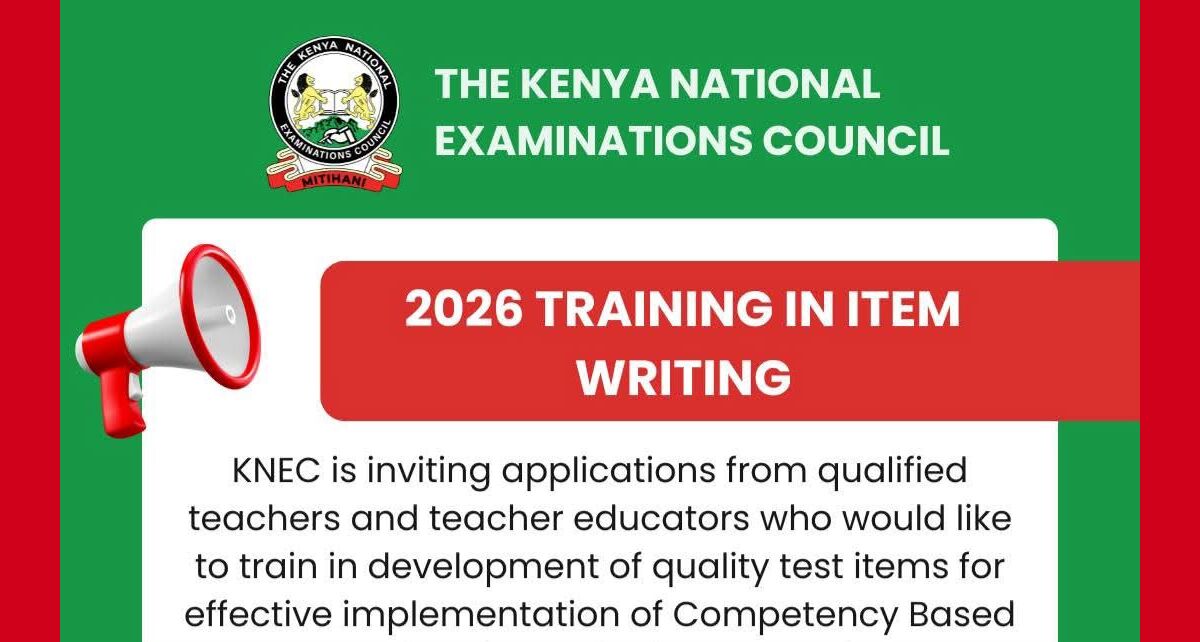
The Kenya National Examinations Council (KNEC) has officially opened applications for teachers and teacher educators to undergo training in test item writing. This capacity-building exercise, set for April 2026, is designed to bolster the implementation of Competency Based Assessment (CBA) across various education levels in Kenya.
According to a circular issued by KNEC Chief Executive Officer Dr. David Njengere, the council aims to maintain high examination standards by certifying a pool of professionals who can be engaged as contracted specialists from time to time.
Eligibility and Qualifications
Prospective applicants must be registered with the Teachers Service Commission (TSC) and possess a minimum of three years of teaching experience. Candidates are required to be subject specialists currently handling classes in Primary School (Grades 1-6), Junior School (Grades 7-9), Senior School (Grade 10), or Teacher Training Colleges.
KNEC emphasizes that applicants must have “unquestionable and irreproachable integrity” and be conversant with the current curriculum designs. A formal recommendation from the head of the applicant’s institution is a mandatory requirement for consideration.
Scope of Training
The training covers an extensive range of learning areas, including special needs education (SNE) and stage-based curricula. It also targets educators in Diploma in Teacher Education (DTE) and Diploma in Secondary Teacher Education (DSTE) programs.
Key subjects include core areas like Mathematics, English, and Kiswahili, alongside technical fields such as Aviation, Mechatronics, and Marine Technology. Notably, teachers who have previously undergone item writing training with KNEC are not eligible to apply.
Application Process and Deadline
Interested educators must submit their applications through the official KNEC portal. The council has specified that all documents must be uploaded as a single continuous PDF document to facilitate the review process.
The deadline for online submissions is April 13, 2026. Only successful candidates will be contacted via the phone or email addresses provided during registration. For further updates on teacher opportunities and professional development, visit teacher.co.ke.
Available Subjects and Learning Areas by Level
Teachers and teacher educators may apply for training in the following subjects and learning areas, categorized by education level:
Table 1: Primary School Learning Areas (Age-Based Curriculum)
S/No. | Learning Area |
|---|---|
1 | Mathematics |
2 | English |
3 | Kiswahili |
4 | Science and Technology |
5 | Social Studies |
6 | Home Science |
7 | Art & Craft |
8 | Agriculture |
9 | Music |
10 | Physical and Health Education |
11 | Christian Religious Education |
12 | Islamic Religious Education |
13 | Kenyan Sign Language |
Table 2: Junior School Learning Areas
S/No. | Learning Area |
|---|---|
1 | English |
2 | Kiswahili |
3 | Kenyan Sign Language |
4 | Mathematics |
5 | Integrated Science |
6 | Pre-Technical Studies |
7 | Social Studies |
8 | CRE |
9 | IRE |
10 | Business Studies |
11 | Agriculture |
12 | PE and Sports |
13 | Home Science |
14 | Computer Science |
15 | Visual Arts |
16 | Performing Arts |
Table 3: Senior School Learning Areas
S/No. | Learning Area |
|---|---|
1 | English |
2 | Literature in English |
3 | Kiswahili |
4 | Fasihi ya Kiswahili |
5 | Kenyan Sign Language (KSL) |
6 | Sign Language |
7 | Arabic |
8 | French |
9 | German |
10 | Chinese Mandarin |
11 | Indigenous Language |
12 | Christian Religious Education (CRE) |
13 | Islamic Religious Education (IRE) |
14 | Community Service Learning (CSL) |
15 | Business Studies |
16 | History & Citizenship |
17 | Geography |
18 | Music and Dance |
19 | Fine Arts |
20 | Theatre and Film |
21 | Physical Education (PE) |
22 | Sports & Recreation |
23 | Core Mathematics |
24 | Essential Mathematics |
25 | Biology |
26 | Physics |
27 | Chemistry |
28 | General Science |
29 | Computer Science |
30 | Home Science |
31 | Agriculture |
32 | Aviation |
33 | Building Construction |
34 | Electricity |
35 | Metalwork |
36 | Power Mechanics |
37 | Woodwork |
38 | Media Technology |
39 | Marine and Fisheries Technology |
Table 4: Special Needs Education Assessments (Stage-Based Curriculum)
S/No. | Learning Area |
|---|---|
1 | Foundation Level Learning Areas |
2 | Intermediate Level Learning Areas |
3 | Prevocational Level Learning Areas |
4 | Vocational Level Learning Areas |
Table 5: Teacher Education – DTE-PP&P
S/No. | Learning Area |
|---|---|
1 | English |
2 | Kiswahili |
3 | Mathematics |
4 | Science and Technology |
5 | Kenyan Sign Language |
6 | Physical and Health Education |
7 | Home Science |
8 | Agriculture |
9 | Christian Religious Education |
10 | Islamic Religious Education |
11 | Educational Resources |
12 | ICT Integration in Education |
13 | Education Assessment |
14 | Research Skills |
15 | Educational Leadership and Management |
16 | Child Development and Psychology |
17 | Inclusive Education |
18 | Sociological and Philosophical Foundations of Education |
19 | Historical and Comparative Foundations of Education |
20 | Curriculum Studies |
21 | Art and Craft |
22 | Music |
23 | Indigenous Languages |
24 | French |
25 | German |
26 | Mandarin |
27 | Arabic |
Table 6: Teacher Education – DSTE
S/No. | Learning Area |
|---|---|
1 | Educational Assessment |
2 | Educational Management & Leadership |
3 | Education Resources |
4 | ICT Integration in Education |
5 | Research Skills |
6 | Child Development and Psychology |
7 | Inclusive Education |
8 | Sociological and Philosophical Foundations of Education |
9 | Historical and Comparative Foundations of Education |
10 | Curriculum Studies |
11 | Community Service Learning |
12 | English |
13 | Kiswahili |
14 | Kenyan Sign Language (KSL) |
15 | Indigenous Language |
16 | Arabic |
17 | French |
18 | German |
19 | Mandarin |
20 | Mathematics |
21 | Chemistry |
22 | Physics |
23 | Biology |
24 | Integrated Science |
25 | Agriculture |
26 | Health, Food and Nutrition |
27 | Home Science |
28 | Health Education |
29 | Home and Hospitality Management |
30 | Computer Science |
31 | Christian Religious Education (CRE) |
32 | Islamic Religious Education (IRE) |
33 | Social Studies |
34 | Business Studies |
35 | History and Citizenship |
36 | Geography |
37 | Life Skills Education (LSE) |
38 | Sports and Recreation |
39 | Physical Education (PE) |
40 | Applied Arts |
41 | Visual Arts |
42 | Fine Arts |
43 | Music and Dance |
44 | Performing Arts |
45 | Theatre and Film |
46 | Wood Technology |
47 | Building Construction |
48 | Welding and Fabrication |
49 | Electrical Technology |
50 | Electrical Installation |
51 | Aviation Technology |
52 | Leather Work |
53 | Hairdressing and Beauty Therapy |
54 | Power Mechanics Technology |
55 | Pre-Technical Studies |
56 | Fashion Design and Interior Décor |
57 | Metal Technology |
58 | Textile Design Technology |
59 | Mechatronics |
60 | Media Technology |
Important Application Notes
- Deadline: Online applications must be submitted by 13th April 2026.
- Application Portal: Apply via https://markingapp.knec.ac.ke
- Document Format: All required documents must be uploaded as one continuous PDF file.
- Notification: Only shortlisted candidates will be contacted via the phone or email provided during registration.
- Exclusion: Teachers who have previously been trained by KNEC in Item Writing are not eligible to reapply.
Final Remarks
This initiative by KNEC represents a significant step toward strengthening assessment quality and alignment with Competency Based Assessment frameworks across Kenya’s education system. Educators who meet the criteria are encouraged to apply promptly and contribute to the development of robust, learner-centered assessment tools.
Dr. David Njengere, MBS
Chief Executive Officer
Kenya National Examinations Council